
11.1 Diversity and Inclusion
Surface-level, Deep-level, and Hidden Diversity
Surface diversity, deep diversity, and deep diversity are categories of personal attributes—or differences in attributes—that people perceive to exist between people or groups of people.
Surface-level diversity refers to differences you can generally observe in others, like ethnicity, race, gender, age, culture, language, disability, etc. You can often quickly and easily observe these features in a person. And people often do just that, making subtle judgments at the same time, which can lead to bias or discrimination (see definitions below).
Deep-level diversity, on the other hand, reflects differences that are less visible, like personality, attitude, beliefs, and values. These attributes are generally communicated verbally and non-verbally, so they are not easily noticeable or measurable. You may not detect deep-level diversity in a coworker, for example, until you get to know them.
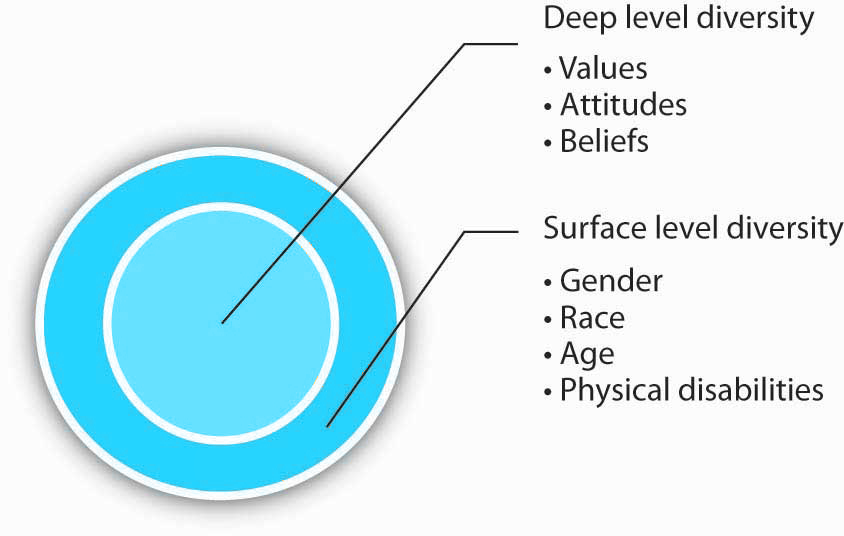
Image Description
Figure 11.1 is a diagram of two concentric circles used to illustrate layers of diversity. The outer ring is labelled Surface level diversity with examples: gender, race, age, and physical disabilities. The inner circle is labelled Deep level diversity with examples: values, attitudes, and beliefs. The figure shows that visible characteristics represent only the surface, while deeper, less visible traits lie beneath.
Hidden diversity includes traits that are deep-level but may be concealed or revealed at the discretion of individuals who possess them (Lambert & Bell, 2013). These hidden traits are called invisible social identities (Clair et al., 2005) and may include sexual orientation, a hidden disability (such as a mental illness or chronic disease), racial heritage (Phillips et al., 2009) or socioeconomic status.
Why Diversity Matters
Diversity matters because when we communicate with people who are different from us in a fundamental way, it can be difficult to go from miscommunication and misunderstanding to synergy and high performance in a business context. In an interpersonal context, it is also difficult to make the leap from thinking the other person is “ridiculous” to challenging ourselves to develop our skills in listening and empathy before leaping to dismissive judgment.
Since the 1970s, Canada has had an official policy of multiculturalism. This policy says people do not have to give up parts of their identity or their culture, such as their religion, language, or customs, provided that they don’t interfere with others’ rights and freedoms as defined in Canada’s Constitution or Charter of Rights and Freedoms. Canada is often described as a mosaic, in contrast to the melting pot philosophy of the United States to the south. Where the melting pot expects people to blend in, assimilate, and become “American,” the Canadian mosaic identity is arguably more fluid, enabling people to retain their cultures, customs, traditions, or other elements of their heritage.
In addition, the Canadian Employment Equity Act has a mandate to “encourage the establishment of working conditions that are free of barriers, correct the conditions of disadvantages in employment and promote the principle that employment equity requires special measures and the accommodation of differences for the four designated groups in Canada” (Employment and Social Development Canada, 2018).
 The Employment Equity Act identifies and defines the designated groups as:
- Women
- Aboriginal peoples – Indian, Inuit or Métis;
- Persons with disabilities; and
- Members of visible minorities
If you’re interested in reading about more legal cases related to diversity and discrimination, the Ontario Human Rights Legal Support Centre has a description of recent cases related to diversity and discrimination, where you can see the latest outcomes of those cases.
Diversity and inclusion should hopefully be more than just buzzwords and avoiding lawsuits. When done right and applied to people in a work or professional context, having diversity provides a competitive advantage for businesses and increased satisfaction for employees who can put their full potential to work. According to Ryerson University’s Diversity Institute (Ryerson University, 2015), the business case for diversity in Canada has several strong points, including that diversity has improved company performance and shareholder stock value. We will discuss more of the benefits and challenges of workplace diversity later in this chapter.
Key Diversity-Related Concepts and Definitions
When trying to understand how to communicate more effectively, it’s important to understand that people’s identities are diverse and complex, often shaped by their environment, history, and experience. We sometimes generalize in order to make sense of or evaluate a situation, but being mindful and listening carefully will help us do a better job of responding to a situation, case by case, instead of falling back on bias, stereotypes, and discrimination. We’ll look at each one of these definitions in turn.
Bias is a subjective opinion, preference, prejudice, or inclination, either for or against an individual or group, formed without reasonable justification that influences an individual’s or group’s ability to evaluate a particular situation objectively or accurately (mygsa.ca, 2015). Many people in the workplace are unaware of the biases they may have, which is why self-reflection is such an important part of how to improve interpersonal communication through self-awareness.
Similarly, a stereotype is a false or generalized, and usually negative, conception of a group of people that results in the unconscious or conscious categorization of each member of that group, without regard for individual differences (mygsa.ca, 2015). When we learn about other groups of people, it’s easy to forget that individuals make up groups. For good interpersonal communication to occur, it is important to be open, to listen, and to recognize that person as a unique individual.
Discrimination is defined as “the unequal treatment of groups or individuals with a history of marginalization either by a person or a group, or an institution which, through the denial of certain rights, results in inequality, subordination and/or deprivation of political, education, social, economic, and cultural rights” (mygsa.ca, 2015). Discrimination in the workplace can take many forms. For example, a female board member once told the author that after board meetings in previous decades, all the other board members—all men—would go socialize afterwards, typically to play golf. When she tried to join them, they said, “These excursions are just ‘for the boys’ …. You understand, right?”
Understanding how bias, stereotypes, and discrimination affect the workplace and how people communicate are essential to understanding the move toward inclusive practices.
This section is adapted from:
Diversity and Cultural Competency | OER Commons by Laura Lucas, Austin Community College. which is licensed under a CC BY 4.0 attribution.
NSCC Organizational Behaviour by NSCC is licensed under a Creative Commons Attribution-NonCommercial-ShareAlike 4.0 International License, except where otherwise noted.
Professional Communications by Olds College is licensed under a Creative Commons Attribution 4.0 International License, except where otherwise noted.
5.1 An Introduction to Workplace Diversity in Organizational Behaviour by Rice University, Open Stax, which is licensed under a Creative Commons Attribution-NonCommercial-ShareAlike 4.0 International License, except where otherwise noted.
2.1 Demographic Diversity in Organizational Behaviour by Seneca College is licensed under a Creative Commons Attribution-NonCommercial 4.0 International License, except where otherwise noted.