
Chapter 4: The Writing Process 3: Drafting
Learning Objectives
- ENL1813 Course Learning Requirement 4: Use effective reading strategies to collect and reframe information from a variety of written materials accurately.
i. Identify the organizational structure of a variety of written messages (ENL1813ABGHMPST CLR 4.1)
ii. Separate main ideas from subordinate ideas in written materials (ENL1813 ABGHMPRST CLR 4.1) - Apply outlining techniques to begin drafting a document.
- ENL1813 Course Learning Requirement 1: Plan, write, revise, and edit short documents and messages that are organized, complete, and tailored to specific audiences.
i. Apply standard patterns of organization (ENL1813GP CLR 1.3)
ii. Recognize and use basic patterns of standard English (ENL1813HIMST CLR 1.3)
iii. Incorporate elements of business writing style (ENL1813B CLR 1.4)
iv. Apply proper use of sentence structure, grammar, and punctuation (ENL1813B CLR 1.5)
v. Craft unified and coherent sentences and paragraphs (ENL1813A CLR 1.3)
vi. Support message content with visual elements (ENL1813T CLR1.6) - Apply the principles of reader-friendly document design to various written formats.
Now that you’ve planned out your document and gathered information that meets your audience’s needs, you’re just about ready to start drafting the document’s message. At this point it’s worthwhile reminding yourself that the words you start entering in your word processor will look different from those your reader will eventually read. By the end of the drafting stage examined in this chapter, your document will be partway there, but how much revising you do in the fourth stage (see Ch. 5) depends on how effectively you’ve organized your message in the first step of this third stage.
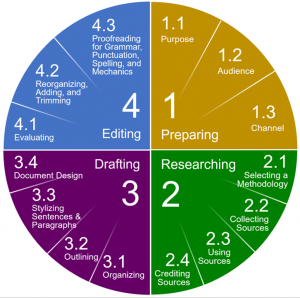
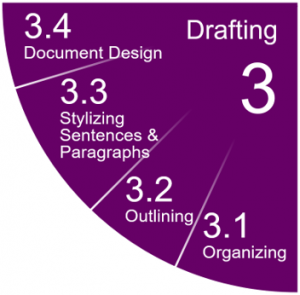
Figure 4: The four-stage writing process and Stage 3 Breakdown