
4.3 House of Quality in New Product Development
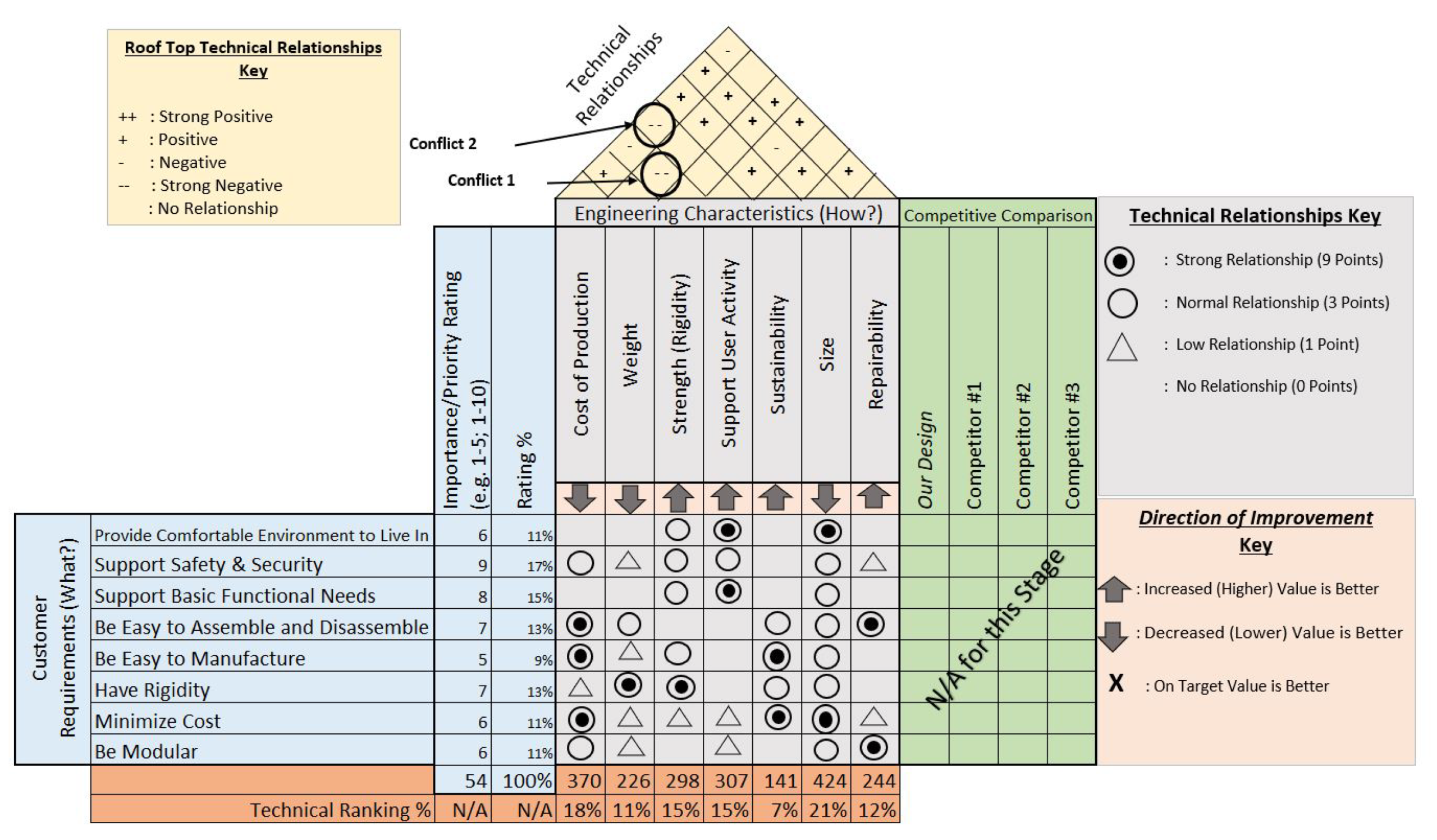
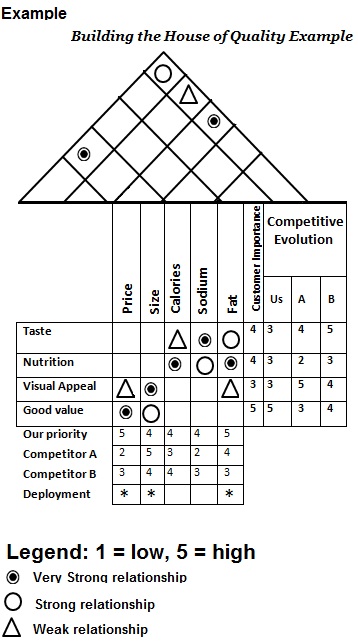
The House of Quality (HOQ) is a central tool in the Quality Function Deployment (QFD) methodology, designed to ensure that customer requirements are systematically translated into specific technical features during new product development. By providing a structured and visual planning matrix, the HOQ helps organizations connect what customers want with how those needs can be met through product design and engineering. This approach enables companies to prioritize design objectives, balance trade-offs, and make well-informed decisions throughout the development process. Figure 4.3.1 illustrates a completed House of Quality.
Key Components of the House of Quality
- Customer Requirements (WHATs). This section lists the voice of the customer, their needs, expectations, and preferences. These are typically gathered through market research, surveys, interviews, and direct customer feedback.
- Technical Characteristics (HOWs). These are the specific, measurable product features or engineering attributes that are designed to meet the customer’s requirements. They represent the technical response to the WHATs.
- Relationship Matrix. Located at the centre of the HOQ, this matrix shows the strength of the relationship between each customer requirement and each technical characteristic. It helps identify which technical features have the most significant impact on customer satisfaction.
- Roof (Correlation Matrix). The triangular “roof” at the top of the diagram displays the correlations among the technical characteristics themselves, highlighting areas where features may support or conflict with each other. This helps in identifying possible trade-offs or synergies in the design.
- Competitive Assessment. This section compares the company’s product with those of competitors from the perspective of customer requirements. It provides valuable insights into the product’s relative strengths and areas for improvement.
By using the House of Quality, companies can ensure that the voice of the customer is central to the product development process, leading to products that better satisfy market needs and stand out in competitive markets. (IONOS Editorial Team, 2020)
Benefits of Using the House of Quality
The House of Quality (HOQ) offers several significant benefits in the new product development process:
- Customer-Centric Development: HOQ ensures that product development is guided by actual customer needs and preferences, rather than relying on assumptions. This leads to products that are more likely to satisfy market demands and achieve commercial success.
- Effective Resource Allocation: By clearly identifying and prioritizing the most critical customer requirements and corresponding technical characteristics, companies can focus their resources on areas that will have the greatest impact.
- Enhanced Cross-Functional Communication: HOQ serves as a common framework that brings together teams from marketing, engineering, manufacturing, and other departments. This alignment improves collaboration, reduces misunderstandings, and streamlines the decision-making process.
- Competitive Advantage: The structured analysis provided by HOQ helps companies pinpoint opportunities to outperform competitors. By understanding both customer expectations and competitor offerings, firms can develop products with distinctive features and superior value.
Overall, the House of Quality helps organizations develop products that are better aligned with customer needs, more competitive in the marketplace, and more efficiently brought to market. (Mathias, 2023)
Implementing the House of Quality
The implementation of the House of Quality (HOQ) begins with identifying customer requirements or needs and translating these into measurable product features or technical characteristics. Next, the development team evaluates how each technical characteristic addresses the identified customer requirements and assesses how effectively competitors are meeting those same needs. Based on this analysis, the team sets specific targets or goals for each technical characteristic. The roof matrix is then used to identify potential conflicts or synergies between different technical characteristics. By following these steps, organizations can ensure that product development is closely aligned with customer expectations.
These steps are further illustrated in the following video.
Video: “House of Quality Tutorial: How to Build a House of Quality” by Wondershare Edraw [6:08] is licensed under the Standard YouTube License.Transcript and closed captions available on YouTube.