
5.7 Customer Involvement & Capital Intensity
Customer Involvement
Customer involvement refers to the degree to which customers participate in or influence the execution of a process. It is a critical dimension of process design, particularly in service operations, and can significantly affect cost, quality, customization, and delivery performance.
The extent, nature, and form of customer involvement can vary widely depending on the industry, product or service type, and competitive priorities. Below are key forms of customer involvement:
Self-Service
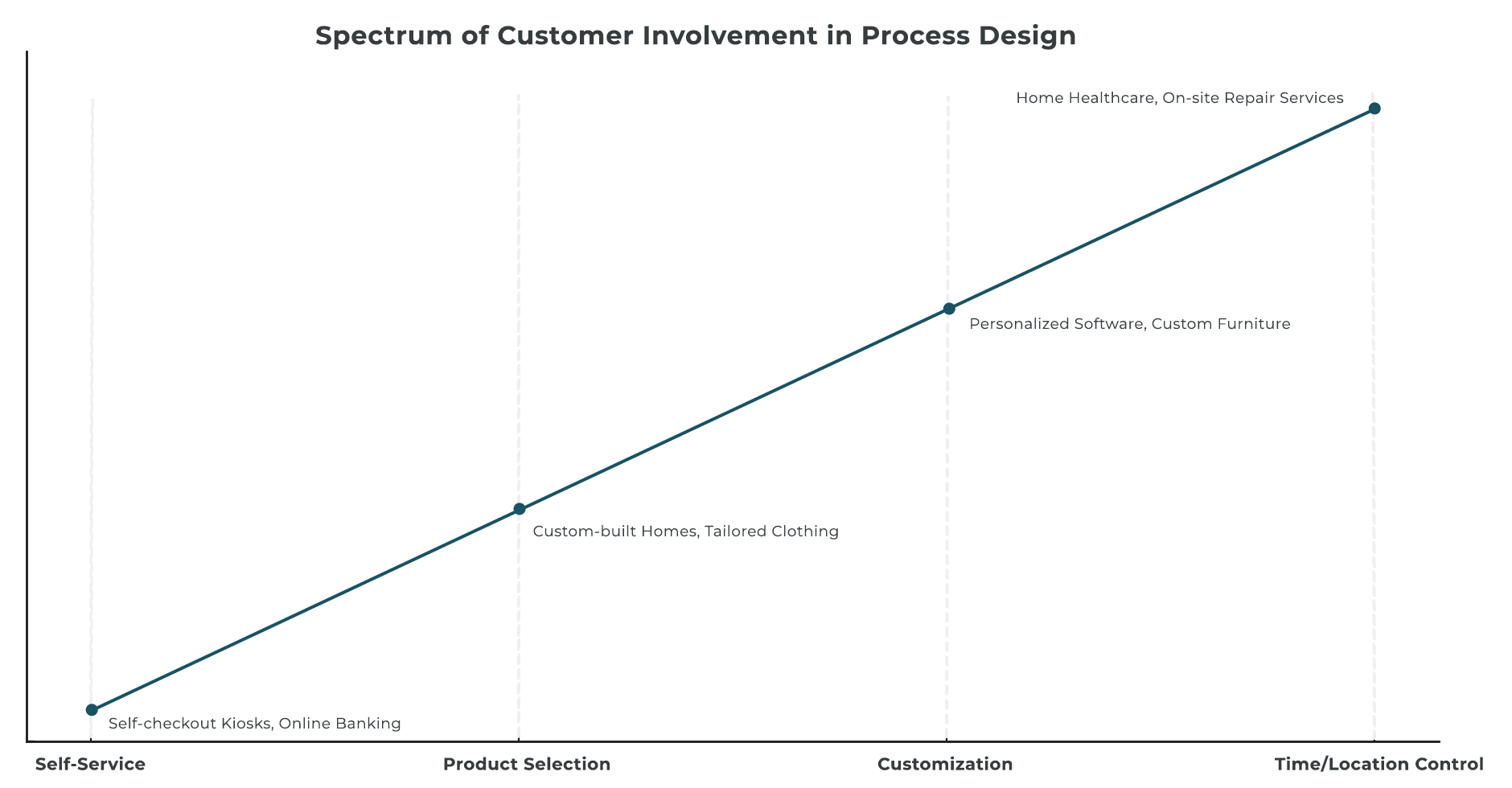
In self-service models, customers perform tasks traditionally handled by the provider. This approach is common in retail environments where cost leadership is a strategic priority. Examples include:
- Self-checkout kiosks in supermarkets
- Online banking and ticket booking
- Assembly-required products such as furniture, toys, or bicycles
Self-service reduces labour and operational costs for the firm, which can be passed on to customers in the form of lower prices. It also empowers customers with greater control and convenience.
Product Selection and Customization
In businesses that compete on customization, customers may be actively involved in specifying or even designing the product or service. This form of involvement is particularly prevalent in:
- Custom-built homes
- Tailored clothing
- Personalized software solutions
Here, the customer’s role extends beyond consumption to co-creation, influencing both the design and production phases. This high level of involvement enhances satisfaction but requires flexible processes and close communication.
Time and Location Determination
In many service settings, the time and location of service delivery are dictated by the customer. This introduces additional complexity into process design. Key considerations include:
- Will the service be delivered on the provider’s premises, at the customer’s location, or at a third-party site?
- Is the service scheduled by appointment, or is it on demand?
- How will the process accommodate variability in customer availability and preferences?
Examples include home healthcare services, on-site equipment repair, and mobile car detailing. These scenarios require flexible scheduling systems and mobile resources.
Strategic Implications
The level of customer involvement has significant implications for:
- Process efficiency: Higher involvement may reduce provider workload but increase variability
- Cost structure: Self-service can lower costs, while customization may increase them
- Customer experience: Involvement can enhance satisfaction and perceived value
- Process design: Requires adaptable workflows, communication systems, and sometimes co-location of resources
Capital Intensity
Capital intensity refers to the extent to which a production process relies on equipment and technology relative to human labour. A process is considered capital-intensive when a significant portion of its cost structure is attributed to machinery, automation, and infrastructure rather than workforce expenses.
As technological capabilities continue to advance and costs decline, operations managers are presented with a broader spectrum of choices—from manual, labour-intensive systems to highly automated, capital-intensive operations. The selection of capital intensity must align with the organization’s competitive priorities, such as cost efficiency, flexibility, quality, and responsiveness.
Types of Automation
Automation plays a central role in capital-intensive operations. It refers to systems, equipment, or processes that operate with minimal human intervention. There are two primary types of automation:
Fixed Automation (Hard Automation)
- Designed for high-volume, repetitive tasks
- Utilizes special-purpose equipment to perform a fixed sequence of operations
- Common in assembly lines and mass production environments
- Offers high efficiency but low flexibility
Flexible Automation (Soft Automation)
- Capable of adapting to different product configurations
- Uses programmable equipment that can change the sequence of operations
- Suitable for moderate-volume, high-variety production
- Balances efficiency and adaptability
Strategic Considerations
While automation and capital intensity can offer significant advantages, they also come with trade-offs. Key considerations include:
| Advantages |
Disadvantages |
|---|---|
| Increases productivity and throughput | High initial investment and maintenance costs |
| Enhances product consistency and quality | It may not be cost-effective for low-volume or highly customized operations |
| Reduces reliance on manual labour and human error | Can reduce workforce flexibility and adaptability |
| Supports scalability and long-term cost reduction | May conflict with competitive priorities focused on personalization or service |
Importantly, capital intensity is not always the optimal choice. For firms that compete on customization, service quality, or personal attention, a more labour-intensive approach may better align with strategic goals. In such cases, skilled human resources may deliver greater value than automation.
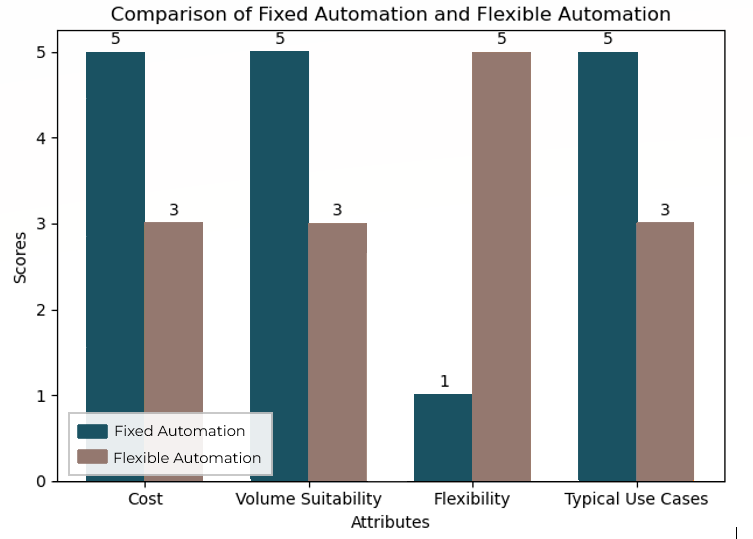
Figure Explanation:
- Cost: Fixed automation typically involves a higher upfront investment due to specialized equipment.
- Volume Suitability: Fixed automation is ideal for high-volume, repetitive tasks; flexible automation suits moderate volumes.
- Flexibility: Flexible automation excels in adaptability, making it suitable for varied product configurations.
- Typical Use Cases: Fixed automation is used in mass production (e.g., automotive assembly), while flexible automation is common in environments requiring frequent changeovers (e.g., electronics or custom manufacturing)
Video: “Process Strategy Decisions” by DrAnand [10:21] is licensed under the Standard YouTube License.Transcript and closed captions available on YouTube.
“4. Process Management: Types of Process and its Implication in Operation Strategy” from Operations Management by Sudhanshu Joshi is licensed under a Creative Commons Attribution-NonCommercial 4.0 International License, except where otherwise noted.—Modifications: Used sections 6, & 7; reworded; added further content.