
10.3 Non-Manufacturing Layouts
Layout planning plays a critical role in both manufacturing and service organizations. This section explores key layout types, categorized into non-manufacturing and manufacturing environments.
Office Layout
Office layouts are designed to optimize the flow of information and work by strategically positioning personnel, equipment, and workspaces. The process typically involves:
- Identifying primary work areas and traffic patterns.
- Analyzing interrelationships among personnel, equipment, and information flow.
- Designing systems that reflect organizational hierarchy and workflow.
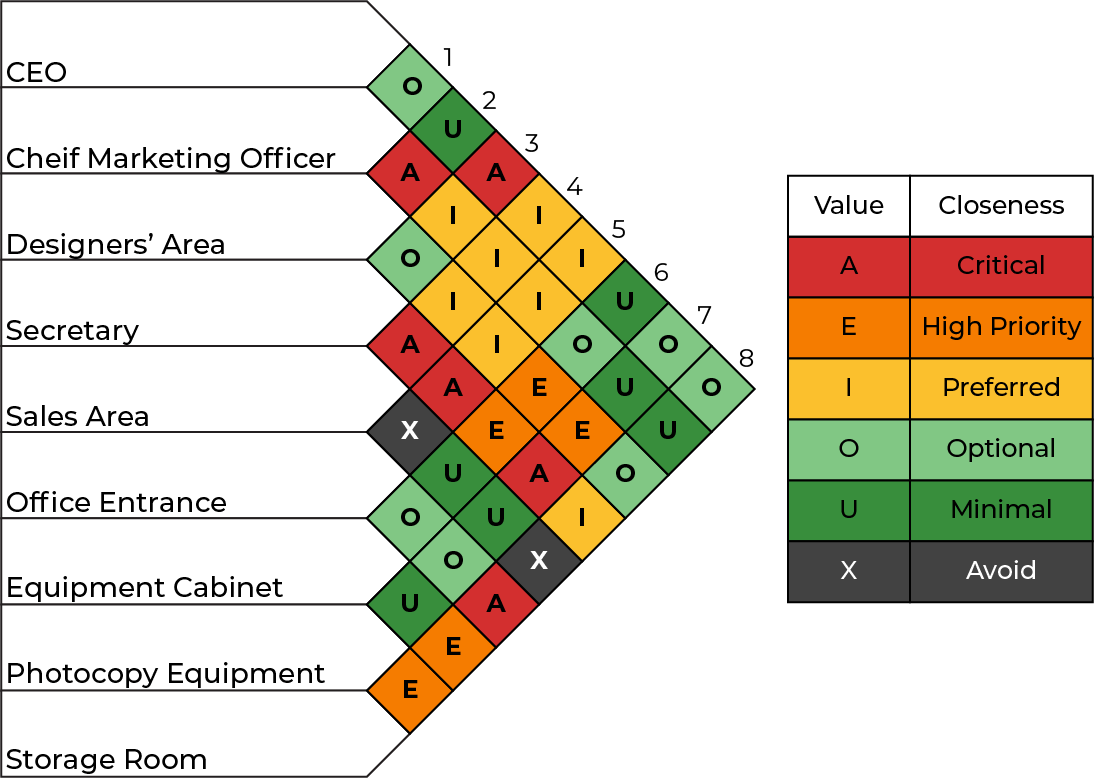
A commonly used tool in office layout planning is the Office Relationship Chart, which visually represents how the work of one employee affects others. For example, if the Chief Marketing Officer frequently collaborates with the design team, their offices should be located in close proximity.
10.3.1 Image Description
A relationship chart displays workspace proximity preferences among office areas. The left column lists locations: CEO, Chief Marketing Officer, Designers’ Area, Secretary, Sales Area, Office Entrance, Equipment Cabinet, Photocopy Equipment, and Storage Room. A diamond grid shows coded relationships using letters and colours: A (Critical, red), E (High Priority, orange), I (Preferred, yellow), O (Optional, light green), U (Minimal, dark green), and X (Avoid, gray). For example, the CEO has a critical relationship (A) with the Chief Marketing Officer, a preferred relationship (I) with the Designers’ Area, and an optional relationship (O) with the Secretary. The Sales Area should avoid proximity (X) to the CEO and Equipment Cabinet. A legend on the right explains the colour and letter codes representing degrees of closeness and importance.
Retail Layout
Retail layouts are crafted to maximize revenue per square foot by influencing customer behaviour and enhancing the shopping experience. A well-designed layout can attract customers, increase the time they spend in-store, and guide them toward high-margin products.
Key objectives of retail layout design include:
- Attracting and retaining customer attention.
- Encouraging exploration and impulse purchases.
- Highlighting best-selling or high-margin merchandise.
- Facilitating smooth traffic flow and reducing congestion.
Several common retail layout types are used depending on the store’s goals and space constraints.
Grid Layout
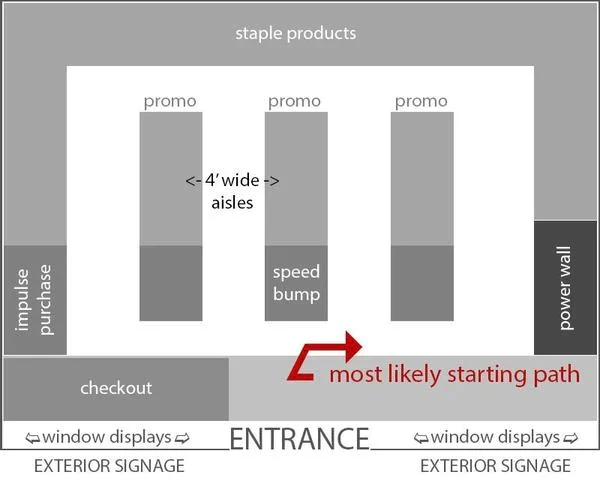
This layout features long, straight aisles that maximize product display and allow customers to browse efficiently. Items are grouped logically (e.g., dishwashing detergents, sponges, and towels) to encourage multi-item purchases.
- Best suited for: Grocery stores, pharmacies, and convenience stores.
- Advantages: Efficient use of space, easy navigation, and high product visibility.
Figure 10.3.2 “Grid Store Layout”, FDEd (Click to enlarge)
Diagonal Layout
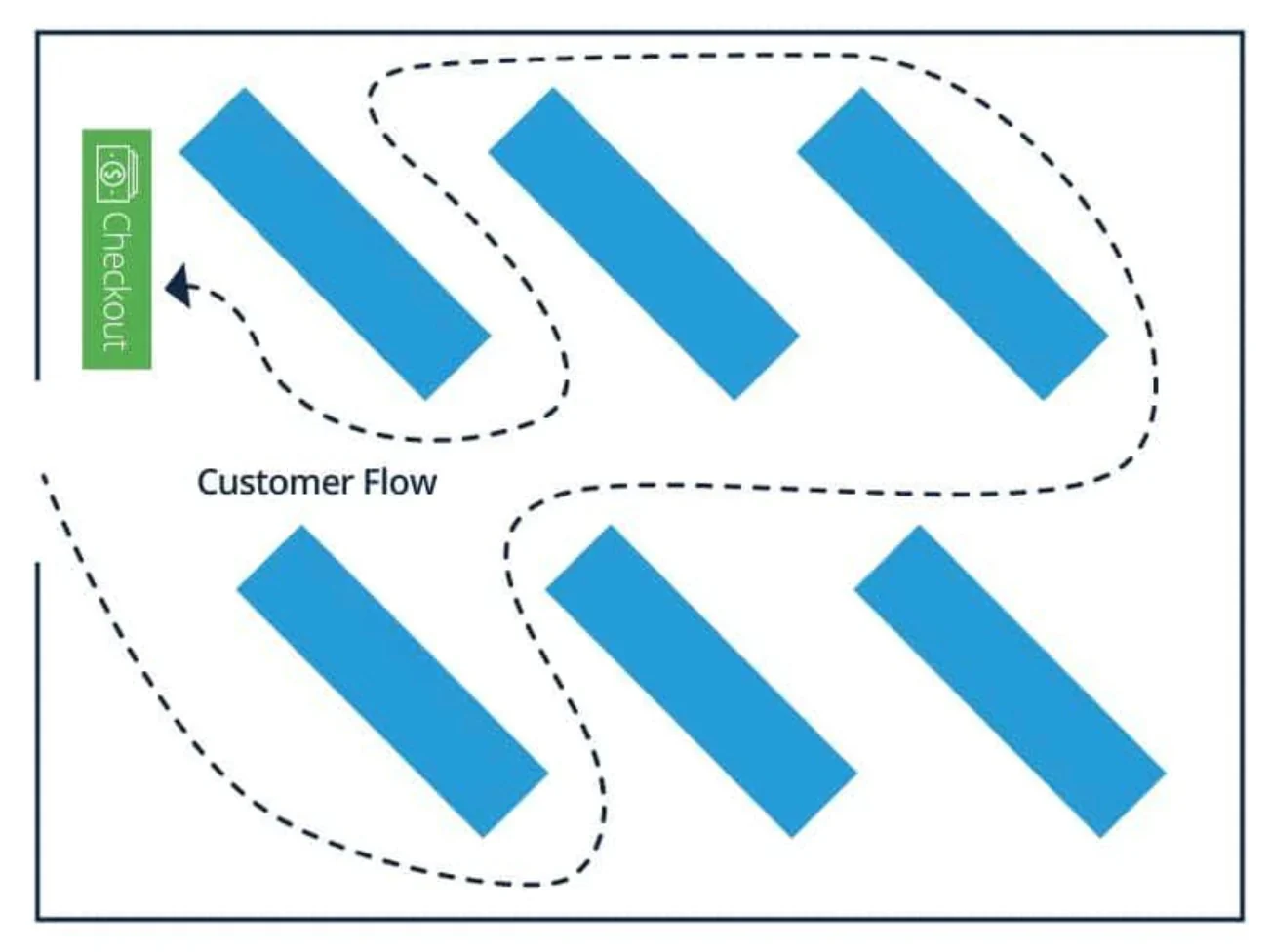
A variation of the grid layout, this design places aisles at an angle to increase product exposure and improve sightlines.
- Ideal for: Smaller retail spaces.
- Benefits: Enhances visibility and encourages movement through the store.
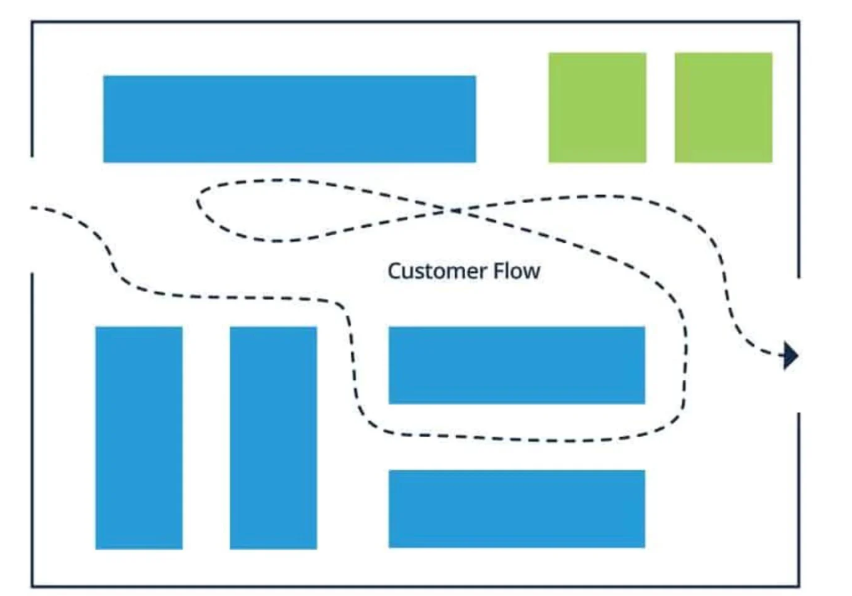
Loop Layout (Racetrack Layout)
This layout creates a guided path that leads customers through the entire store, ensuring they pass by all merchandise before reaching the checkout.
- Used by: IKEA and similar large-format retailers.
- Features: A main corridor with smaller layout variations in central areas.
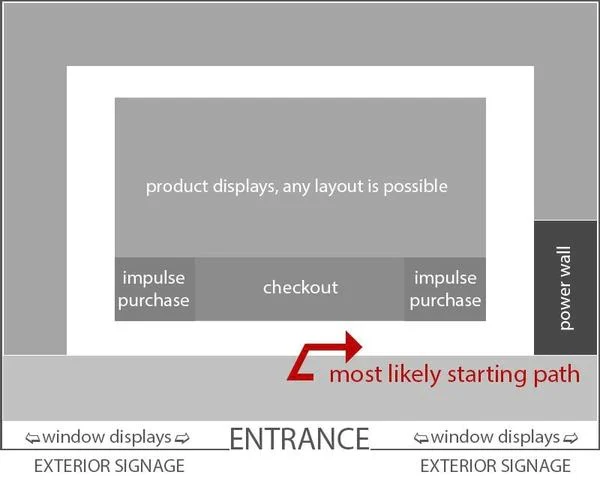
Free-Flow Layout
Unlike structured layouts, this design allows customers to move freely, encouraging browsing and discovery.
- Best for: Upscale or experiential retail environments.
- Design elements: Power walls, signage, and flexible product displays.

Spine Layout
This layout uses a central aisle (the “spine”) that connects various departments or product zones.
- Common in: Department stores and large retail chains.
- Purpose: Draws customers deeper into the store while exposing them to featured products.
“16 Layout Planning: Types of Layout” from Operations Management by Sudhanshu Joshi is licensed under a Creative Commons Attribution-NonCommercial 4.0 International License, except where otherwise noted.—Modifications: Used sections 16.4; reworded; removed content from stages; added further content.